
If you live or work in Indian River County, or frequently visit the beautiful Treasure Coast region, you will inevitably
Oct 16, 2026

Car Accident Posted on Sep 17, 2026

You’re driving down I-95, Florida’s Turnpike, US-1, or another Treasure Coast highway when suddenly there’s an object in your lane—a piece of metal, a tire, construction material, or cargo that fell from a truck.
You have seconds to react.
Whether you hit the debris or swerve to avoid it, the resulting crash can cause devastating injuries. Then comes an unexpectedly difficult question: Who is responsible when the thing that caused your accident is simply lying in the road?
At Hoskins, Turco, Lloyd & Lloyd, we want Treasure Coast drivers to understand that road debris accidents can involve far more complicated liability questions than an ordinary two-vehicle collision. Identifying where the debris came from—and whose negligence put it there—can become one of the most important parts of an injury claim.
In this article, our accident attorneys how Florida law treats these crashes, who may be responsible, and what evidence matters.
The person or business responsible for putting the debris on the roadway may potentially be liable, but the answer depends on how the object got there and the evidence available to prove it.
Potentially responsible parties can include a driver who failed to secure a load, the owner of the vehicle, a trucking or transportation company, a company responsible for loading cargo, or another person or business whose negligence caused the hazard.
In other circumstances, an object may have come from the vehicle itself rather than its cargo. That can raise different questions involving vehicle inspection, maintenance, repair, or potentially defective equipment.
This is what can make road debris cases so challenging: the person who left the dangerous object behind that caused the accident may be nowhere in sight or impossible to track down.
Potentially. A commercial trucking accident may require examining the actions of more than just the person behind the wheel.
Depending on the facts and applicable law, an investigation may consider who owned the truck, who employed or contracted with the driver, who loaded the cargo, who was responsible for securing it, and whether equipment failure or maintenance contributed to the loss.
That is why determining liability should not necessarily stop after identifying the truck. A thorough investigation asks a broader question: What went wrong, who had responsibility for preventing it, and what evidence proves it?
When a tire, wheel component, piece of metal, or another vehicle part separates from a vehicle, the investigation may shift from cargo securement to questions involving inspection, maintenance, repairs, equipment condition, or other potential causes.
A commercial vehicle owner or operator may be investigated to determine whether a dangerous condition should have been identified or addressed before the vehicle entered the roadway. Depending on the circumstances, maintenance providers, parts manufacturers, or other parties could also warrant investigation. Their responsibility should not be assumed; it must be supported by the facts and applicable law.
Yes. Even if another person negligently allowed debris to enter the roadway, you could potentially share responsibility if the evidence shows you should have seen the object and had a reasonable opportunity to slow down, change lanes, or safely avoid it. Factors such as visibility, traffic, speed, following distance, the size and location of the debris, and how much time you had to react can all become important when determining fault.
Florida follows a modified comparative negligence system. Under Florida Statute §768.81, if you are partly responsible for an accident, your damages can generally be reduced in proportion to your percentage of fault.
For example, if you sustained $100,000 in damages but were found 20% at fault for failing to avoid visible road debris, the award would generally be reduced by 20%, to $80,000. Under the current statute, a person found more than 50% at fault for their own harm cannot recover damages in a negligence action to which the rule applies.
This is one reason road debris cases can become contentious. An insurance company may argue that you had enough time to see and avoid the hazard—even when someone else’s negligence put it in your path in the first place.
Physical contact with the debris is not necessarily the only relevant issue in determining whether another party’s negligence caused an accident.
A dangerous object suddenly appearing in a travel lane may force a driver into an emergency maneuver. The resulting accident could involve another vehicle, a guardrail, a concrete barrier, or a rollover without the vehicle ever touching the debris itself.
The key question becomes what caused the chain of events. That makes evidence such as photographs, video, witness statements, vehicle damage, roadway markings, and accident reconstruction particularly important.
Because the responsible vehicle may have left the scene before the crash occurs, these cases can become evidence-intensive.
Useful evidence may include:
The goal is to reconstruct what happened before the debris ever entered your path.
Put safety and medical needs first, then preserve as much evidence as reasonably possible.
When a piece of cargo, tire, equipment, or other debris causes a serious accident, don’t assume that because the responsible vehicle is gone, no one can be held accountable.
These cases can require tracing an object back to its source, identifying every party involved in loading and transporting it, preserving time-sensitive evidence, analyzing insurance coverage, and responding to attempts to shift blame onto the injured driver.
If road debris caused your accident on the Treasure Coast, call the law firm with decades of experience with these types of complex cases. The sooner the circumstances can be investigated, the better the opportunity may be to identify and preserve evidence of what—or who—put that dangerous object in your path.
We serve clients throughout the Treasure Coast, with offices in Port St. Lucie, Fort Pierce, Vero Beach and Okeechobee.
Call us today for a free consultation at 866-930-6435.
Who pays if something falls off a truck and damages my car?
If negligence caused the object to fall, the person or entity responsible may potentially be liable for resulting damages. Determining who that is can require investigating the driver, vehicle owner, trucking company, cargo-loading parties, and other entities involved.
Is it illegal to drive with an unsecured load in Florida?
Florida Statute §316.520 requires vehicles to be constructed or loaded to prevent their loads from dropping, shifting, leaking, blowing, or otherwise escaping, and contains additional load-securement requirements.
What happens if I hit debris and don’t know where it came from?
Identifying the responsible party may be difficult, but an investigation can look for video, witnesses, 911 reports, identifying information on the debris, police records, and other evidence. Insurance coverage available under your own policy may also need to be reviewed based on the circumstances and policy terms.
Can I have a claim if I swerved to avoid debris?
Potentially. A vehicle does not necessarily have to strike the debris for it to play a causal role in an accident. The specific facts and evidence will determine whether another party can be held responsible.
What if debris from a semi-truck caused my accident?
The investigation may extend beyond the truck driver to the carrier, vehicle owner, parties involved in loading or securing cargo, maintenance providers, or other potentially responsible entities, depending on how the debris reached the road.
Should I keep the road debris after an accident?
Do not endanger yourself by retrieving an object from an active roadway. If debris has safely been recovered, speak with your attorney or insurer before altering or discarding potentially important evidence.
How quickly should I contact a lawyer after a road debris crash?
Prompt investigation can be particularly important because video may be overwritten, witnesses can become harder to locate, vehicles can be repaired, and physical evidence can disappear. Florida also imposes legal deadlines on injury claims, so waiting can create additional problems.
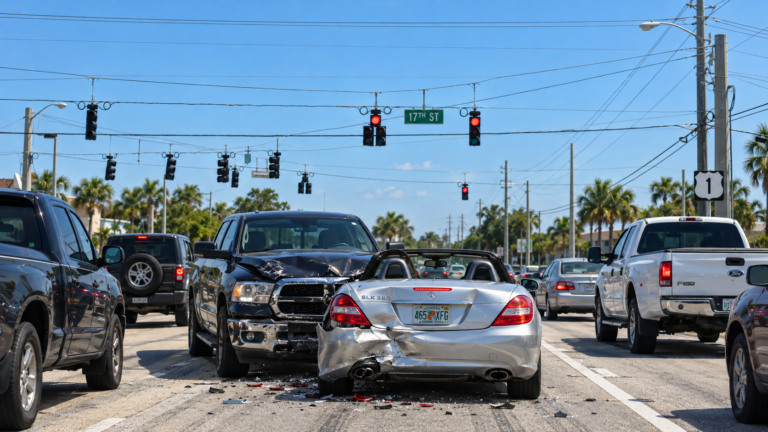
If you live or work in Indian River County, or frequently visit the beautiful Treasure Coast region, you will inevitably
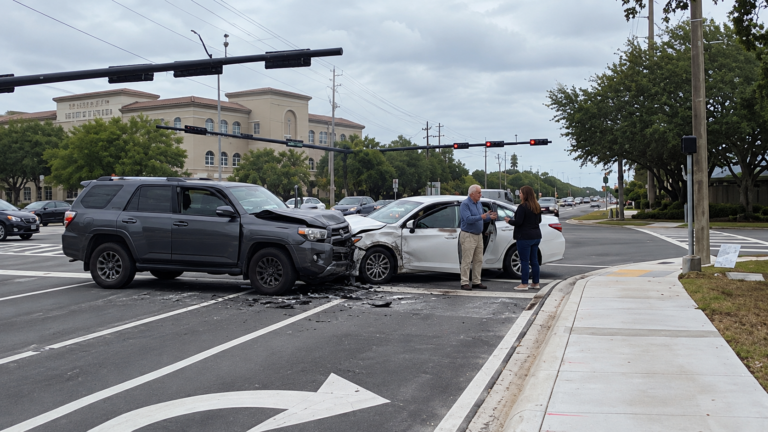
Snowbird season brings more drivers—and unique accident risks—to Vero Beach and the Treasure Coast. Learn what to do after a

You did everything right. You paid for car insurance. You followed the rules of the road. You were driving through
Phone: (772) 344-7770
Fax: (772) 344-3838
Phone: (772) 464-4600
Fax: (772) 465-4747
Phone: (772) 577-7551
Fax: (772) 794-7773
Phone: (863) 357-5800
Fax: (863) 763-2237
As the law firm Florida has trusted for over 40 years to fight on their behalf, we are more than ready to represent you. Put our experience and reputation to work. If you need help with any legal matter, whether it’s a personal injury, workers’ compensation, disability or bankruptcy case, contact us now. The consultation is absolutely free.
Get the answers you need. We’ll review your case today, for free.
Se Habla Español
"*" indicates required fields
 Port St. Lucie